Please consult:emt@emtjj.com
Phone/ Whatsapp /WeChat: +86 18098161417(Mr LV)

Meta description: Space is a hotel's most expensive asset. Discover how multifunctional, modular, and custom commercial furniture can shrink your footprint, lift guest satisfaction, and raise revenue per square meter.
In hospitality, you don't sell square meters — you sell the experience inside them. Yet for most hotels, space remains the single most expensive asset on the balance sheet: every square meter of guestroom, lobby, or dining floor carries construction cost, energy cost, staffing cost, and the opportunity cost of the room it could have been.
The answer is not to build smaller, but to furnish smarter. Space-efficient commercial furniture — multifunctional units, modular systems, wall-mounted and built-in solutions — lets hotels deliver the feel of a larger room without expanding the footprint. Done right, it is not a compromise on comfort. It is a competitive advantage.
Space efficiency directly affects three numbers every hotelier watches:
Revenue per available square meter — a flexible room that converts from sleeping to working to entertaining can justify a higher ADR (average daily rate) and capture more guest types.
Occupancy and conversion — compact, cleverly furnished rooms appeal to modern travelers. Industry surveys consistently show travelers favor hotels that offer innovative, space-saving solutions over those that simply pack more furniture into a room.
Operational cost — fewer, smarter pieces mean faster housekeeping turnaround, less inventory to maintain, and fewer replacements over the life of the property.
Modern hotel rooms are no longer used exclusively for sleeping. Business travelers work in them, families gather in them, and "bleisure" guests live in them for days at a time. Multifunctional commercial furniture is what allows one room to be a bedroom, an office, and a lounge — without feeling like any of them is an afterthought.
The guestroom is where space efficiency earns its keep. Here are the highest-impact solutions:
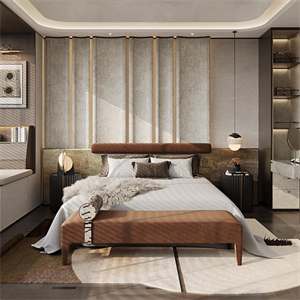
Multifunctional and convertible pieces. A sofa bed with high-density foam and reinforced mechanisms gives you two functions in one footprint. Murphy (wall) beds deliver a full sleeping surface when needed and free the entire floor when folded away. Fold-down desks and wall-mounted worktables provide a workspace or dining surface that disappears between guests.
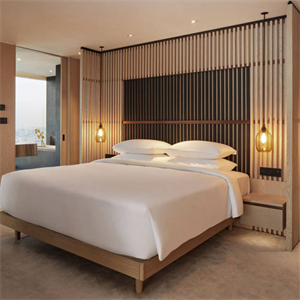
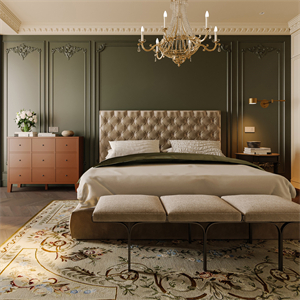
Integrated headboard and storage systems. The headboard wall is the most underused real estate in the room. A well-designed headboard unit combines bedside lighting, USB charging, shelving, and concealed storage — removing the need for separate nightstands, floor lamps, and luggage racks. One built-in wall unit can replace three free-standing pieces.
Platform beds with under-bed storage. Drawer bases and lift-up storage beds absorb luggage, extra bedding, and guest belongings that would otherwise sit on the floor and eat the walkway.
Floating furniture. Wall-mounted nightstands, suspended desks, and floating TV consoles free up floor area and make a compact room feel visibly lighter and more open. Vertical, full-height wardrobes move storage upward, where it costs nothing, instead of outward, where it costs floor space.
Custom joinery for awkward layouts. Irregular room shapes — sloped ceilings, curved walls, narrow corridors — are exactly where bespoke commercial furniture wins. A curved seating banquette built to follow a window wall, or a wardrobe unit that merges with the bedside system, can reclaim over 15% more storage while widening the walkway by centimeters that guests actually notice.
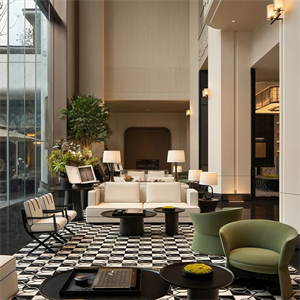
The lobby has become the hotel's living room — a place to check in, work, meet, and socialize, often simultaneously. Fixed, single-purpose seating no longer makes sense.
Modular sofas and sectionals can be reconfigured from intimate two-seat clusters to open event seating in minutes.
Stackable chairs and folding tables store compactly and deploy instantly for functions, meetings, or quiet hours.
Mobile work pods and sound-dampening lounge seating with integrated power turn corners and niches into productive space.
For wellness hotels and resort properties, the same logic extends to spa lounges and wellness areas: lightweight, reconfigurable furniture keeps calm zones calm while letting operators rearrange for group classes or private sessions.
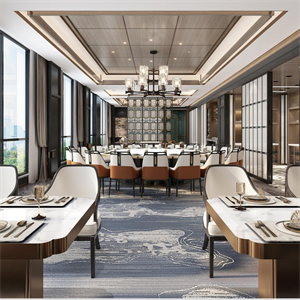
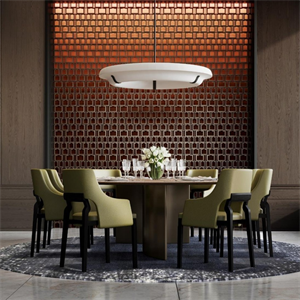
Restaurants and banquet halls face a daily tension: they need seating density at peak hours and open, flexible space the rest of the time. Commercial-grade nestable and stackable dining chairs — in solid wood or leather-upholstered designs that still look premium — let staff add 20–30 covers in minutes and clear the floor just as fast. Banquet seating on lightweight modular bases and tables with removable leaves give venues the same flexibility that event planners now expect as standard.
Terrace, poolside, and rooftop spaces are profit per square meter waiting to happen — but only if the furniture works as hard as the indoor collection. Weather-resistant teak loungers, rattan modular seating, and stackable outdoor chairs resist sun, salt, and rain, so the space stays rentable year-round without constant replacement. Modular outdoor lounges reconfigure for daybeds by the pool in the morning and dining for a beachfront event by evening — the same footprint, two revenue streams.
Whatever the space, the same five principles separate rooms that feel "small but clever" from rooms that feel cramped:
Every piece earns its footprint. If a piece performs only one function, it must earn its floor space through design quality, storage contribution, or traffic value.
Vertical before horizontal. Storage should climb walls before it spreads across floors.
Proportion over quantity. One correctly scaled, well-made piece beats two bulky ones. Slim-profile casegoods with rounded edges keep corridors and circulation zones open.
Traffic flows first. Furniture plans should be validated against door swings, drawer pull-outs, and housekeeping access — efficiency that blocks housekeeping isn't efficiency.
Durability is part of the space math. Commercial furniture is built to contract-grade standards — reinforced joinery, commercial finishes, tested mechanisms — so it doesn't need early replacement. A piece that lasts twice as long is effectively half the furniture inventory.
To actually capture these gains, procurement should demand more than attractive pieces:
Commercial-grade construction — reinforced frames, high-density foam, abrasion-resistant upholstery rated for daily use.
Custom capability — can the factory build to your exact dimensions and floor plans, including joinery for irregular spaces?
Material honesty — solid teak, walnut, and rattan not only age beautifully, they hold up to hotel cycles far better than veneer and imitation finishes; genuine leather wears in, not out.
Tested mechanisms — for sofa beds, Murphy beds, and folding systems, ask for mechanism cycle counts and samples before you commit.
One-stop scope — suppliers that cover guestroom, lobby, F&B, and outdoor collections deliver consistent design language and simplify logistics, installation, and after-sales.
Space efficiency is not about squeezing guests into smaller rooms — it is about making every square meter work harder for the guest experience and the P&L. With the right commercial furniture strategy — multifunctional guestroom systems, modular public-area seating, flexible dining solutions, and durable outdoor collections — a hotel can feel larger, serve more guest types, turn rooms faster, and renew less often.
In an industry where space is the scarcest asset, the smartest furniture is the kind that multiplies it.
Hotline:+86 0757-28787057
Address:Building J, No.1 Fumin Industrial Zone, Taoyuan Town, Heshan City
Mailbox:emt@emtjj.com
Phone:+86 18098161417(Mr LV)
Phone:+86 13501474044(Miss Zhang)
Address:Building J, No.1 Fumin Industrial Zone, Taoyuan Town, Heshan City
Email:emt@emtjj.com
Phone:+86 18098161417(Mr LV)
+86 13501474044(Miss Zhang)

Business


 简体中文
简体中文 English